





 Tiếng Việt
News
Import and Export Risk: The Exposures Businesses Must Manage Themselves
TIS Vietnam Insurance Broker | Series: What businesses should know about insurance | Published: [30/10/2026]
In our previous article, we set out ten exposures facing importers and exporters, following a shipment from packing through to the point of sale. This article turns to the part of that risk that cannot be transferred to insurers under standard cover, and which a business must therefore manage itself.
In the course of trade, a business may cut its price to keep a buyer, absorb extra cost to meet a delivery date, or accept a loss to protect a relationship. Each decision has its own commercial logic. Not every business loss, however, can be transferred to an insurer.
Below are five exposures common in import and export trade that fall outside standard marine cargo and trade credit cover. For these, the most effective protection lies in the business’s own contracts, processes and documentation. The year-end renewal season is a good time to review them.
Summary
Marine cargo insurance responds mainly to physical loss of or damage to the goods caused by an insured peril. Trade credit insurance protects against non-payment of trade receivables, principally where the buyer becomes insolvent or in cases of protracted default, subject to the policy terms. Losses arising from commercial decisions, product quality, delay, documentary errors or ordinary loss in transit usually fall outside both. These are risks the business must retain and manage itself.
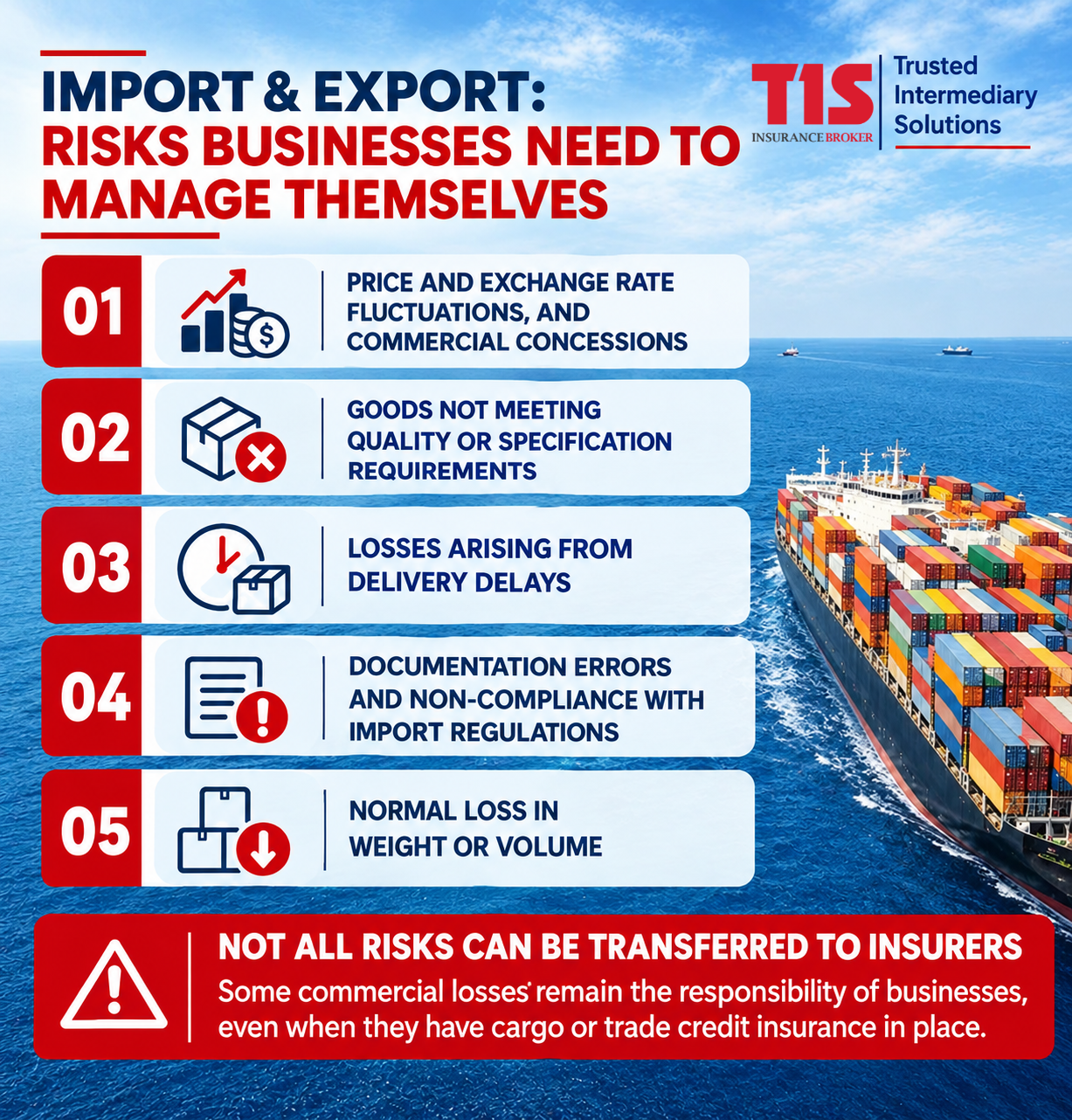
Five exposures businesses must manage themselves
1. Price movements, exchange rates and commercial concessions
Falling market prices, currency movements or a buyer’s request for a discount can erode the margin a business expected to earn.
Discounting to keep a buyer, clearing stock or selling at a loss are commercial decisions, and the resulting losses fall outside the scope of insurance. Nor do standard cargo or trade credit policies respond to price or exchange-rate movements, or to loss of anticipated profit.
This is distinct from the position where a buyer, having become liable to pay, is unable to do so. That is a credit risk, and it may be covered under a trade credit policy, subject to its terms.
Practical controls: price adjustment clauses in sales contracts; currency hedging arranged through the business’s bank; and clear limits on commercial concessions.
2. Goods that fail to meet quality or specification
Goods can arrive intact and still be rejected because the size, colour, material or technical specification does not match the order. The cost of rework, remanufacture or a price reduction in these circumstances generally falls outside standard cargo and trade credit cover.
A clear distinction should be drawn between goods damaged in transit and goods that never met the agreed specification. The first may give rise to a claim under the cargo policy, depending on the cause of loss and the policy terms. The second is a matter of contractual performance between buyer and seller.
Where buyer and seller are in dispute over quality, the buyer’s non-payment does not of itself constitute an insured loss under a trade credit policy.
Practical controls: a clear product specification in the contract; pre-shipment inspection; and retained samples and inspection records to support the business’s position if a dispute arises.
3. Delay and its consequences
A late shipment can expose the business to late-delivery penalties, cause it to miss a selling season or jeopardise future orders.
Standard cargo policies exclude loss, damage or expense caused by delay, even where the delay is caused by an insured risk. Physical loss of or damage to the goods caused by an insured peril may be recoverable; late-delivery penalties, loss of revenue and loss of customers are not.
Whether storage, demurrage and detention charges are recoverable depends on their cause and on the policy wording.
Practical controls: realistic lead times with contingency built into delivery schedules; and clearly defined late-delivery penalties and exemptions from liability in the sales contract.
4. Documentation and import compliance
Incorrect labelling, missing documents or goods that fail to meet the importing country’s requirements can result in a shipment being detained, refused customs clearance, re-exported or destroyed. The resulting costs generally fall outside standard cargo and trade credit cover.
A distinction should be drawn, however, between errors in performing the contract and unforeseen changes in government policy or acts of public authorities. Certain political risks may be insurable under specialist programmes, subject to the terms and scope insurers are prepared to accept.
Practical controls: checking the importing country’s requirements before shipment; and reviewing labelling and documents with the buyer and the freight forwarder.
5. Ordinary loss and leakage
Bulk, liquid and agricultural cargoes are prone to ordinary loss in weight or volume, and to ordinary leakage, in the normal course of transit.
Standard cargo policies typically exclude ordinary leakage, ordinary loss in weight or volume, and ordinary wear and tear. A shortage resulting from a fortuitous event within the scope of cover, by contrast, should be assessed on its merits and not confused with ordinary loss.
Practical controls: an agreed allowance for ordinary loss in the sales contract; and independent surveys of weight or quantity at both loading and discharge.
PRE-SHIPMENT COSTS
Certain specialized trade credit insurance programs may consider covering production costs incurred before shipment, depending on the cause of loss and the applicable policy terms and conditions.
However, if the buyer cancels the order or refuses to accept the goods due to a change in its commercial decision, this may give rise to a contractual dispute and would not automatically be covered by the insurance.
Three questions every business should ask
- Which of these five risk categories does your business encounter most frequently in its import and export activities?
- Has your business clearly identified the potential losses that fall outside the scope of its existing insurance coverage?
- What risk management measures does your business have in place to mitigate potential losses arising from risks that cannot be transferred to insurers?
Key points for businesses
These scenarios show that not every import and export risk can be transferred to an insurer. Some fall within cargo cover, some call for specialist insurance, and some are commercial losses the business must manage itself.
Knowing where that line sits tells a business how far its insurance will respond. For the rest, the safeguards lie in its own sales contracts, payment terms, and quality and documentation controls.
Frequently asked questions
If a buyer refuses to pay because it disputes the quality of the goods, will trade credit insurance respond?
Generally not while the dispute remains unresolved. Where buyer and seller disagree over quality or contractual obligations, the debt is typically treated as disputed rather than as an insured loss. Whether a claim can later be considered depends on how the dispute is resolved and on the policy terms.
If cargo is delivered short in weight, will the cargo policy respond?
If the shortfall is ordinary loss for that type of cargo, generally not. If it results from a fortuitous event within the scope of cover, insurers will assess the claim according to the cause of loss and the policy terms.
If a buyer cancels an order while the goods are still in production, is the business covered?
Possibly, if the trade credit policy includes a pre-credit risk extension and the cause of cancellation is an insured event. A buyer simply changing its mind, or cancelling for commercial reasons, will not usually be covered.
How TIS can help
If your business would like to establish which import and export risks are insured, which it needs to manage itself, and which could be transferred, the TIS team is ready to work through it with you: reviewing your exposures against your existing policies, engaging with insurers and recommending suitable solutions.
Note: this article is for general information only and does not constitute advice on any specific insurance policy. Cover depends on the terms of the policy and the decision of the insurer.