




 Tiếng Việt
News
Splitting Factory Insurance Across Multiple Insurers: The Risks at Claim Time
TIS Vietnam Insurance Broker | Series: What businesses should know about insurance | Published: [5 November 2026]
A factory might insure its buildings with Insurer A, its machinery with Insurer B, its raw materials with Insurer C and its finished goods with Insurer D. Each class of asset sits under its own policy, and on paper everything appears to be fully covered.
But if a single incident damages several of those assets at once, who coordinates the claim?
This is an issue we want to highlight, because when a business buys factory insurance, everything can look straightforward. It is often only after a loss that it discovers how much more complicated the claim can be.
1. Why do businesses split their factory insurance?
In our experience, factories in Vietnam end up this way for several reasons:
- Lender requirements: Each loan is secured on its own assets, and each bank may ask for cover to be arranged loan by loan.
- Business relationships: The business wants to maintain relationships with several insurers, partners or personal contacts.
- Local relationships: Some policies are placed through long-standing local partners or personal introductions.
- Phased investment: The buildings come first and the machinery later, followed by additional warehousing and production lines.
- Several departments involved: Each department arranges cover for the assets it manages.
- Different terms on offer: The business chooses each insurer on premium, scope of cover or capacity.
Each decision has its own logic, and sometimes it was not entirely the business’s choice.
Over time, however, a single factory can end up with a large number of separate policies, each with its own terms and its own approach to claims.
2. What difficulties can a business face after a loss?
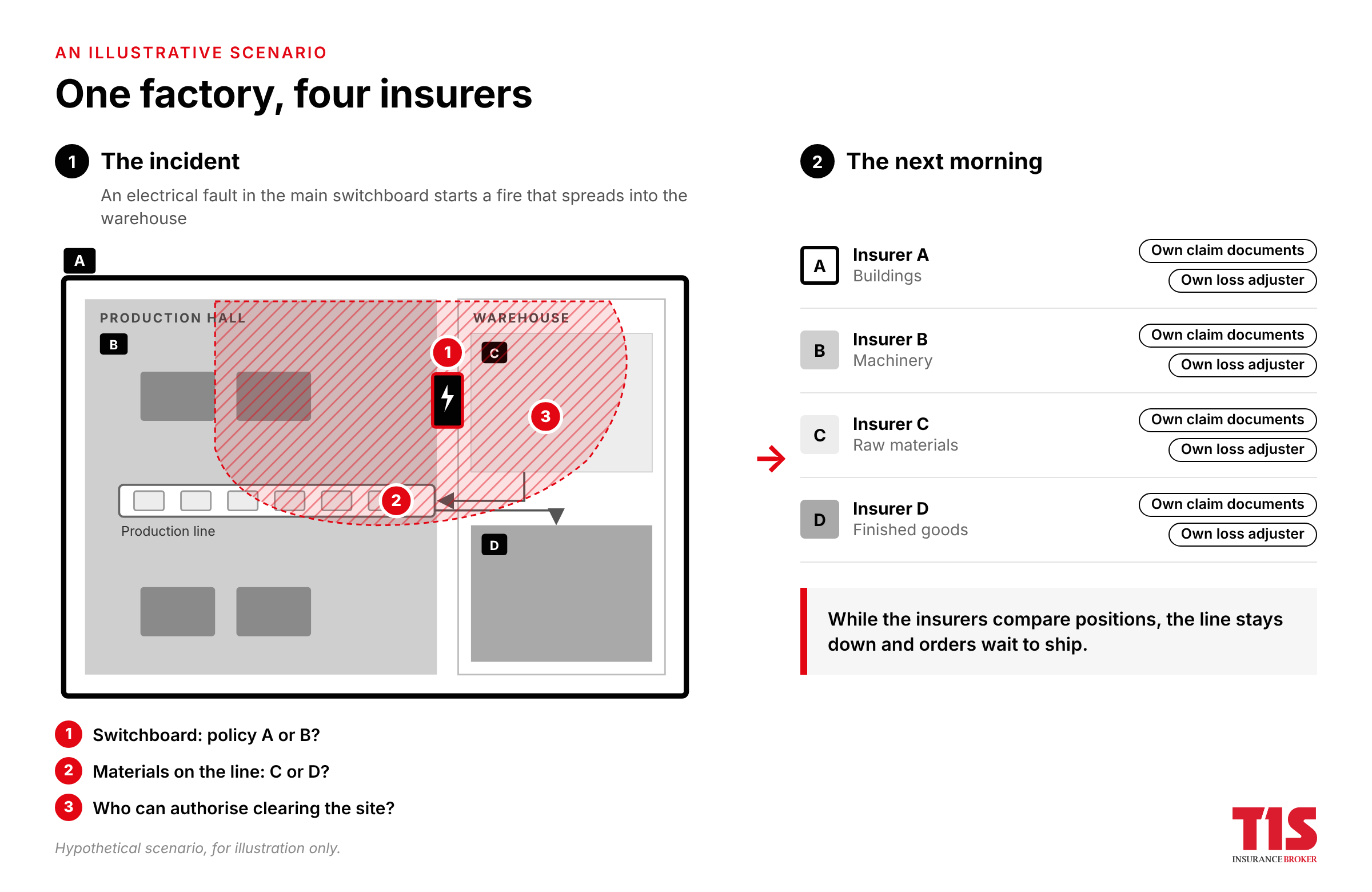
Suppose a factory holds four separate policies: one each for its buildings, machinery, raw materials and finished goods.
An electrical fault starts a fire in the production area, which then spreads to the warehouse. Several classes of assets are damaged at the same time.
The business may now have to deal with four insurers and several loss adjusters, and prepare a different set of claim documents for each.
The difficulties typically surface at three stages.
Stage 1: Establishing the loss and liability
It is hard to tell which policy an asset falls under
Raw materials may be financed from different sources, held in the same warehouse and then moved into production. Once they have become work in progress or finished goods, establishing which policy covers the damaged stock can be very complex.
Shared assets are easily missed or insured twice
Electrical systems, pipework, ancillary equipment and other shared items may not be clearly allocated between the policies.
After an incident, the insurers may need to establish where the loss started, which assets were affected and which policy should respond.
If the parties take different views, the claim can drag on.
One incident, but several amounts the business may have to bear itself
Each policy may have its own scope of cover, deductible and basis of settlement.
Surplus cover under one policy does not automatically make up for a shortfall under another. If an asset is insured for less than its proper value, the claim may also be reduced under the policy terms.
Stage 2: Inspection, clean-up and repair
Agreement from one insurer does not mean agreement from all
Each insurer may require its own inspection and documentation.
While the business wants to clear the site and repair its machinery quickly to restart production, the parties may not yet agree on the cause, the extent of the damage or the remedial plan.
If the business goes ahead with repairs before all parties have been properly involved, proving the loss later may become difficult.
The cost of keeping production going may not be recoverable
The business may need to hire temporary equipment, expedite spare parts, run overtime or outsource production to meet its delivery commitments.
Whether these costs are covered depends on the scope and wording of each policy.
Stage 3: Receiving settlement and restoring production
Settlements arrive piecemeal, while the factory needs to recover as a whole
One policy may already be settled while another is still pending. Meanwhile, the business needs funds to repair the buildings, replace machinery and restore production.
Where a bank is named as loss payee, the use of claim proceeds must also follow the agreement with that bank.
This can slow the factory’s recovery.
Business interruption (BI) cover becomes even harder to arrange
This is an issue that deserves particular attention.
Production lines are usually closely interdependent. An incident in one area can bring the entire factory to a halt.
When each insurer covers only part of the assets, finding an insurer willing to provide business interruption cover for the whole factory becomes very difficult.
No insurer will readily accept liability for business interruption losses when the cause may lie in assets outside its own policy.
3. Bank-required factory insurance: does it have to be a separate policy?
This is one of the most common reasons a business ends up holding several property policies.
Banks require insurance on secured assets to protect their loans. Because the business needs the finance, it usually agrees to arrange cover as each bank requests.
Over time, the same factory can end up with several separate policies.
In our view, businesses can discuss an alternative with their banks.
Rather than a separate policy for each loan, the business can propose a single insurance programme for the whole factory, with each bank’s interest as loss payee set out by agreement.
This helps to align the scope of cover, claims conditions and the management of the insured assets.
What matters is that the bank and the business share the same goal: after a loss, the factory needs to recover quickly so that it can keep operating and generate the cash flow to service its debt.
This approach does, of course, require the agreement of the banks involved.
4. How should a business structure its factory insurance to avoid these problems?
If you currently hold several separate policies, consider the following:
- Review every policy: Identify each asset class, its sum insured, scope of cover, deductible and loss payee.
- Align the policy terms: Avoid each policy wording things differently, which creates overlaps and gaps.
- Consider a single programme: Several insurers can still participate in agreed shares, with one lead insurer coordinating.
- Appoint one point of oversight: Someone to track changes in assets, manage renewals and coordinate claims when a loss occurs.
Comparing the two approaches
| Criterion | Several separate policies | One co-insurance programme |
|---|---|---|
| Policy terms | May differ from policy to policy | Aligned under a single policy |
| Claims liability | Determined policy by policy | Shared in agreed co-insurance proportions |
| Loss adjustment | Several adjusters may be involved separately | Usually coordinated through one lead |
| Deductibles | Several may apply | Applied under the agreed common terms |
| Asset management | Several policies to track | More centralised |
| Insurer relationships | Maintained | Can still be maintained |
Splitting factory insurance across several insurers is not wrong. But where the policies can be brought together into one programme, managing the cover and handling claims become much easier.
5. Three questions for your business
- How many insurers cover your factory today, and is it clear which assets each one covers?
- If several areas were damaged at once, who would coordinate the claim?
- Have you considered a single insurance programme to avoid these problems?
6. Frequently asked questions
Can surplus cover under one policy make up for a shortfall under another?
Usually not. Each policy is assessed on its own sum insured and terms. If an asset is underinsured, the claim may be reduced under the applicable conditions.
Does moving to a single programme mean leaving our current insurers?
Not necessarily. Your current insurers can still participate in one co-insurance programme, with agreed shares and common terms.
Is business interruption (BI) cover harder to arrange in this situation?
It can be very difficult, and it may not be possible to find an insurer willing to provide it at all. A loss in one area can interrupt the entire operation, while each insurer covers only part of the assets.
7. How TIS can help
The TIS team can help you review your existing factory insurance policies, identify overlaps and gaps, and work with insurers and banks to find the right arrangement.
When a loss occurs, TIS can also act as your point of coordination with all parties throughout the claims process.
The aim is to help you keep the relationships that matter, while having an insurance programme that is clear, consistent and easier to rely on when a loss occurs.
What businesses should know about insurance
Insights from practice, to help businesses understand their risks and protect themselves.
TIS Vietnam Insurance Broker
Note: this article provides general information only. Liability for any claim depends on the terms and conditions of each insurance policy and the actual circumstances of the loss.